TheSt Jude storm, also known as Cyclone Christian, and other names, was a severe European windstorm that hit Northwestern Europe on 27 and 28 of October 2013. As of the 29th of October, Britain was still facing further disruptions as a result of the storm, which was the strongest storm to hit Britain in years. The storms hurricane force winds battered both England and wales on its route through Britain causing transport disruption on road, rail, air and sea, and power cuts for hundreds of thousands of homes. Authorities continued to clear away debris and fallen trees following the event while engineers worked on restoring power to homes across England that were still without power over Monday night. According to the Energy Networks Association, 459,000 homes suffered power cuts across England, with 166,000 still disconnected.A 17-year-old girl was among the four people killed in the wake of the storm. According to the environmental agency, dozens of areas in southern England remained on flood alert following the storm. Additonal side affects of the storm included the shutting down of the port of Dover in Kent, disruption of train and tube services, cancelation of more than 130 flights at Heathrow airport, and the blockage of many roads due to fallen trees. Furthermore, Debris falling on to powerlines caused a nuclear power station in Kent to automatically close down both its reactors, leaving its own diesel generators to provide power for essential safety systems. Historical weather experts said the gales were relatively weak in comparison to earlier recorded storms in Britains history such as the Great Storm of 1987.
Image of a demolished car in aftermath of St. Jude Storm due to a fallen tree.
Video of both St. Jude storm and aftermath in Britain.
Mount Etna erupted on Saturday (10/26/13) in Sicily, the
largest island in the Mediterranean Sea. Sicily constitutes an autonomous
region of Italy that extends from the tip of the Apennine peninsula, from which
it is separated only by the narrow Strait of Messina, towards the North African
coast. Mount Etna is its most prominent landmark, which is at 3,320 m (10,890
ft) the tallest active volcano in Europe and one of the most active in the
world. Saturday's eruption spewed glowing lava into the air and sent a vast
plume of smoke over the southern island of Sicily. According to Catania
airport, an international airport near the second largest city in Sicily, The
eruption did not require any villages in the proximity of the mountain to be
evacuated or cause significant disruption. However, airspace over Sicily was
briefly closed as a result of the large plume of smoke sent out from the
eruption. Although the last major eruption was in 1992, volcanic activity is a
constant occurrence for Mount Etna. This latest eruption was preceded by a
series of underground tremors. This incident is the 14th time Mount Etna has
erupted this year.
One of a series of tweeted photos that Italian astronaut Luca Parmitano took from the International Space Station.
Tropical Cyclone Phailan, the
strongest storm to hit India in the last 14 years, made landfall in Odisha
state on Saturday the 12th of October. The storm pulverized the
eastern coast, causing littered wet streets and huge holes in buildings. At least 13 people were killed from trees and
buildings that collapsed when the storm hit, according to the Chief of Police,
Prakash Mishra. The India Disaster Management Authority also confirmed an additional
fatality in Andhra Pradesh state. The death toll had been feared to be much
larger, but mass evacuations of the affected area prior to the storms arrival,
considerably limited the number of deaths, according to officials. Naveen
Patnaik, Odisha’s chief minister, commented on the favorable lack of
fatalities, stating “It is a huge, huge relief.” One of the downfalls of the
precautionary measures instigated before the storm was authorities cutting the electrical
systems in the affected districts, which could take several days to restore
according to authorities. According to meteorologists, Phailan made landfall as
a category 4 hurricane with 140 mph winds. By Sunday it ad depreciated to a
level 1 hurricane with winds of about 80 mph. India evacuated nearly a million
people before the storm hit, almost 900,000 in Odisha alone. Most of the
evacuees were housed in 250 emergency shelters set up in sturdy buildings and
government offices. The storm disrupted power and communication as well as
affecting rail and roads from flooding. Additionally, crops are expected to
suffer from the storms trail of destruction. Before Phailan made landfall,
military units and National Disaster Response Force personnel were deployed to
provide relief supplies and medical services, according to CNN-IBN.
Photograph of Cyclone Phailan
Image of established relief operation in Orissa, India.
Image of one of the established storm centers for the evacuees.
A strangely large and untimely snowstorm hit South Dakota
from 10/3 to 10/5, which averaged 30 inches of snow, with some areas recording
almost 5 feet according to The Weather Channel. Unprepared ranchers and farmers
were devastated by the snowstorm that killed tens of thousands of cattle,
ravaging the state’s $7 billion dollar industry. According to state and industry
officials, approximately 75,000 cattle have died since the record breaking storm
hit the western section of the state. The South Dakota Stock Growers
Association claimed that an estimated 15 to 20 percent of all the cattle in the
state. Many ranchers reported that they
had lost more than half of their cattle. The snow storm came with hurricane-force
winds, driving cattle herds miles away from their ranches in search of shelter.
Martha Wierzbicki, emergency management director for Butte County, South
Dakota, said that trails of dead cattle carcasses were present everywhere after
the storm subsided. Many ranchers have no one to assist them for reimbursement because
of the lack of new congressional subsidies for agriculture producers that would
provide support in such circumstances. State Agriculture Secretary Lucas Lentsch,
called the early-season blizzard “devastating to our producers.” The most
immediate concern, following the blizzard, is the disposal of all the dead
livestock. According to state law they must be burned, buried or rendered
within 36 hours in order to prevent the spread of disease to other cattle or
people in the surrounding communities. Dustin Oedekoven, South Dakota’s state veterinarian,
attested to the importance of disposal, stating that they “can be a significant
source of disease spread, so we want to make sure those carcasses are burned,
buried or rendered as quickly as possible.” The South Dakota Cattlemen’s
Association warned that the effects of the snowstorm would be present years
afterwards. The loss of tens of thousands of cattle, including the prospect of
calves that would have been delivered by many of those cattle, has caused and
will continue to affect the cattle numbers in South Dakota. Additionally, the stress
of the storm will leave its mark on surviving herds, according to the South Dakota
State University Agricultural Extension Service, from the host of ruinous
diseases present from the decaying carcasses.
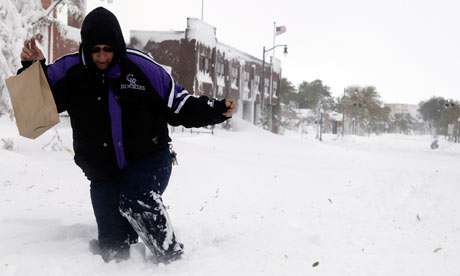
A shopper wades through a large snow drift in downtown Rapid City SOuth Dakota.
Photograph: Chris Huber/AP
Radar image of snowfall for South Dakota during the snowstorm.
Frozen Cattle along Highway 34 east of Sturgis, South Dakota.
Hundreds of thousands of people
evacuated from eastern China after Typhoon Fitow made contact with the shore.
Winds were recorded at upwards of 151 km/h (93mph). The storm made landfall at 01:15 local time on Monday (17:15 GMT Sunday) in
the city of Fuding, China according to Chinese meteorologists. The area received
the highest alert status (red) by authorities. At first, the typhoon caused heavy
rains and widespread power cuts. Areas of China were hit with up to 8 inches of
rain, according to the AFP news agency. The Provincial Flood Control Office
issued a statement explaining that the typhoon had affected 3 million people in
Zhejiang while causing more than 300 million dollars worth of economic damage. According
to Xinhua, the state-run news agency, the Fujian Province evacuated over
177,000 people before the storm hit the coast, while more than 574,000 people
had to leave their homes. Additionally, Xinhua has confirmed at least two
people killed by the typhoon. State media also reported that 65,000 boats were
ordered to harbor for shelter in Zhejiang and Fujian, trains and coach services
were suspended in several cities, and dozens of flights were cancelled. The storm is now moving north-west and is expected to weaken quickly. Typhoon
Fitow is the 23rd tropical storm to hit China this year according to
Xinhua. Therefore China is used to dealing with
extreme weather events but, nonetheless, the risk remains high.
Image of Zhejing and Fujian Provinces that experienced the hardest blow of Typhoon Fitow.
Image of a storm surge in eastern China brought by Typhoon Fitow.
Image of the standstill boats that were order by Chinese authorities to take shelter from Typhoon Fitow.
Video of Typhoon Fitow along with media coverage of the affects of the storm.
A
rock slide killed five hikers and seriously injured another in south-central
Colorado on September 30, 2013. According to Chaffee County Undersheriff, John
Speeze, the boulders from the rock slide were reported as exceeding over 100
tons. The falling rock crashed into a viewing area on a popular day-hike site,
which left a 100 yard gash below Mount Princeton. Rescuers located the five
bodies and the injured13 year-old with a broken leg within the crash site. The
girl was immediately flown to a Denver hospital. According to Speeze "It
was totally unexpected. It caught everybody by surprise." Monica Broaddus,
the sheriff's department spokeswoman, said rescuers left the mountain Monday
afternoon and that the recovery effort would continue only after an engineer
could survey the slide area to insure that it was safe to remove the bodies.
The slide occurred at approximately 11 a.m. on a San Isabel National Forest
trail that led to Agnes Vaille Falls. According to Margaret Dean, a regular
hiker in the area, the trail was a highly recommended tourist location for
hikers. The rock slides will most likely lead to a decrease in tourism in the
area until the rocks can be removed from the trail and safety measures can be
introduced to protect future hikers from vulnerability to the natural hazard.
Image of the aftermath of the rockslide below Mount Princeton, a 14,197- foot mountain.
News Report of the aftermath of the rockslide with images of the affected area and emergency response teams.
On
the afternoon of the 24th of Sepetember a 7.7 magnitude earthquake struck in
Pakistan's remote south-west province of Balochistan. The quake was so powerful
that reports of the tremors were felt as far as India's capital of New Delhi.
An island appeared off the coast near the port of Gwadar following the
earthquake, which incitited local curosity and scientists alike. Although the
island that emerged following the earthquake was a marvel to behold, the quake
itself caused awful destruction and death within the Balochistan province.
According to the Balochistan government spokesman, Jan Muhammad Buledi, 300,000
people had been affected within the six districts of the Province (Awaran,
Kech, Gwadar, Panjgur, Chaghi and Khuzdar). Additionally, Buledi stated that
the current deathtoll in the area was 328 with more than 440 injured. Many
houses were flattened and thousands of people were forced to spend the night in
the open. Noor Ahmed, a 45-year-old farmer in the area, stated that "We
have lost everything, even our food is now buried under mud and water from
underground channels is now undrinkable because of excessive mud in it due to
the earthquake." The regional capitol Quetta has reportedly sent soldiers,
medical teams, and supplies, but the mountainous terrain in the province has
made communication and rescue attempts difficult. Rescuers are concerned about
the easily collapsible mud homes that most of the people in the affected areas reside
in. Since they are not strong enough to survive such devastating earthquakes it
is a possibility that many of the survivors are stuck underneath the rubble.
Picture of the Balochistan Province with the quackes epicentre indicated.
Picture of a collapsed home within the Balochistan Province.
Video describing the devastation within Pakistan's remote south-west province of Balochistan following the 7.7 - magnitude quake that struck on the afternoon of September 24th.